Cleaner cooking solutions: Optimizing biomass briquettes to replace charcoal and mitigate climate change in Tanzania
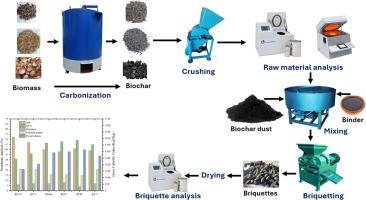
In Tanzania, overreliance on charcoal and firewood for domestic energy has intensified deforestation and environmental degradation, creating an urgent need for sustainable biomass-based fuels. This study investigates the optimization of biomass briquettes produced from locally available agricultural residues (coconut shell, palm kernel shell, rice husk) and forest wastes as sustainable alternatives to charcoal. Click on […]
Despite strong public support for gender equality, Tanzanian women still face barriers
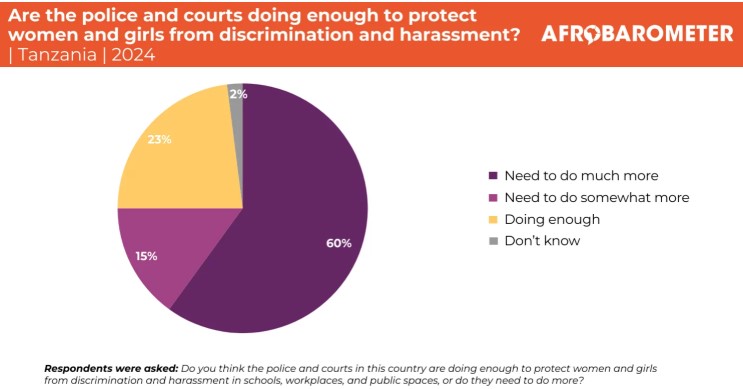
This dispatch provides analysis on the Round 10 of the Afrobarometer Survey capturing citizens’ voices – and in this context depicting that most citizens in Tanzania say police and courts should do more to protect women and girls against discrimination and harassment. Click on View PDF to read more…!
Deepening Tanzania’s Service Sector Integration into Global Value Chains
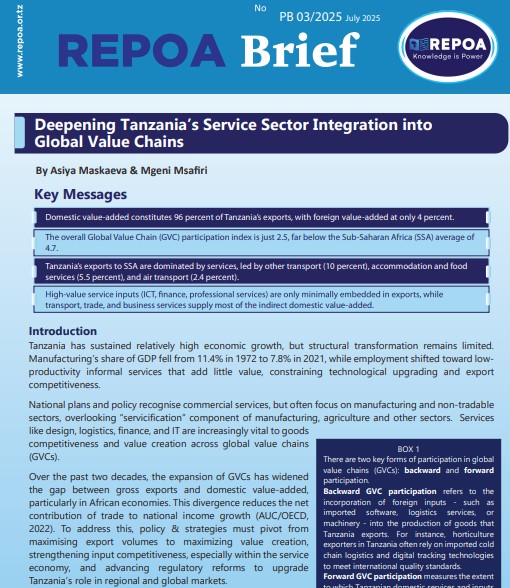
Tanzania’s national plans and policy recognise commercial services, but often focus on manufacturing and non-tradable sectors, overlooking “servicification” component of manufacturing, agriculture and other sectors. Services like design, logistics, finance, and IT are increasingly vital to goods competitiveness and value creation across global value chains (GVCs). This Policy Brief highlights more on that, READ ON…!
Zanzibar Court Users’ Satisfaction Survey 2025
This survey was conducted by REPOA, an independent research institution, to establish a baseline for measuring satisfaction with court services across the country. This baseline data serves as a critical reference point for future impact assessments, helping to track progress over time and highlighting areas requiring further enhancement. The findings from this survey will provide […]
Increasing the Number of Elected Women Representatives in Tanzania’s Parliament: Challenges and Strategies
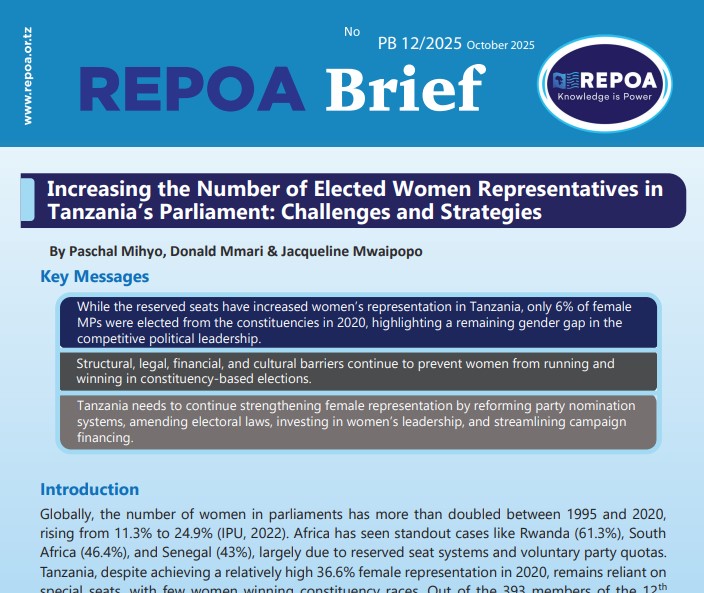
This brief draws on data from the National Electoral Commission, parliamentary records (1985–2020), media reports, and selected secondary studies on women in politics in Tanzania and other African countries, and data compiled from selected local government authority websites (2025) for the number of councillors. This research was conducted in early 2025, immediately after the local […]
Enhancing Private Sector Participation in Tanzania’s Renewable Energy Sector
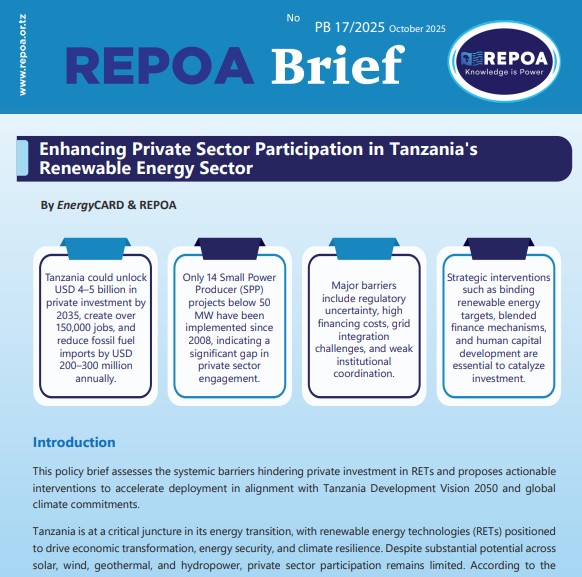
This Policy Brief assesses the systemic barriers hindering private investment in Renewable Energy Technologies (RETs) and proposes actionable interventions to accelerate deployment in alignment with Tanzania Development Vision 2050 and global climate commitments. READ ON…!
Leveraging Renewable Energy for Inclusive Economic Growth in Tanzania
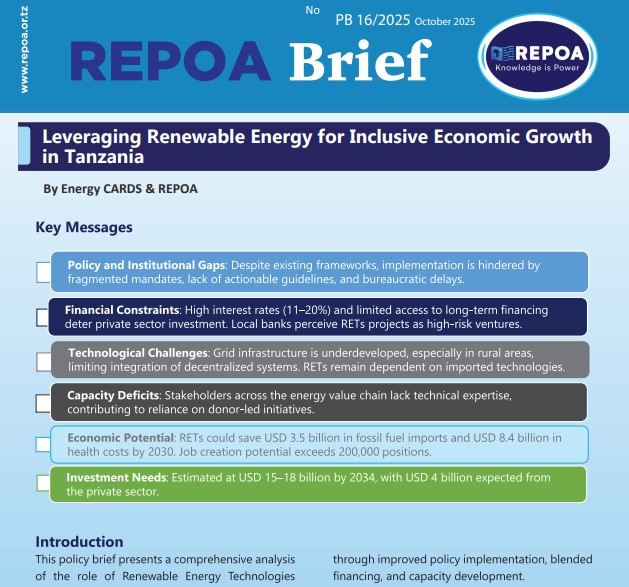
This policy brief presents a comprehensive analysis of the role of Renewable Energy Technologies (RETs) in advancing inclusive economic growth in Tanzania. Despite the country’s vast renewable energy potential, the sector’s contribution to GDP remains below 2%, constrained by financial, institutional, and infrastructural barriers. READ ON…!
Repositioning Tanzania Through Foreign Direct Investment: Trends and Strategic Shifts
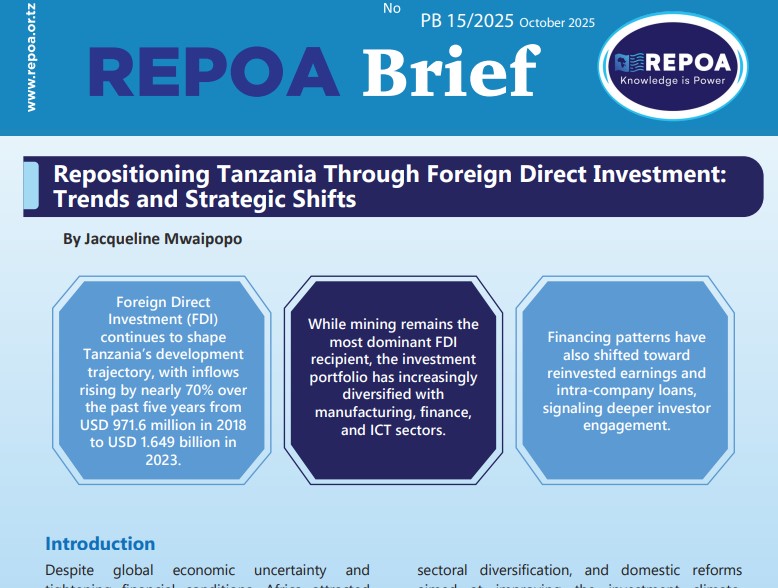
This Policy Brief examines the trends and direction of Foreign Direct Investment (FDI) in Tanzania, with a focus on financing structures, sectoral concentration, sources of investment. READ ON…!
Sustaining Tanzania’s Marine Resources: Opportunities and Challenges for Strengthening Co-Management in Coastal Communities
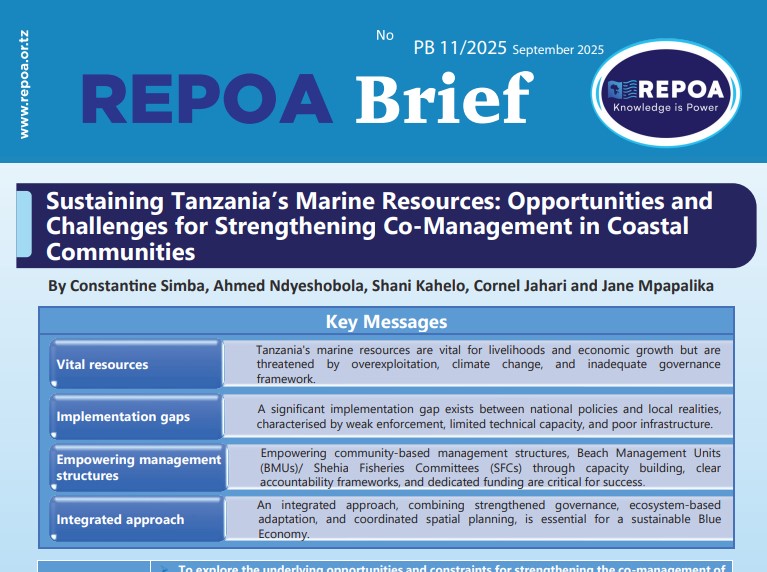
explore the underlying opportunities and constraints for strengthening the co-management of Tanzania’s marine resources in Coastal Communities.
From Shores & Households to Markets: Dynamics of Seaweed Farming in Tanzania
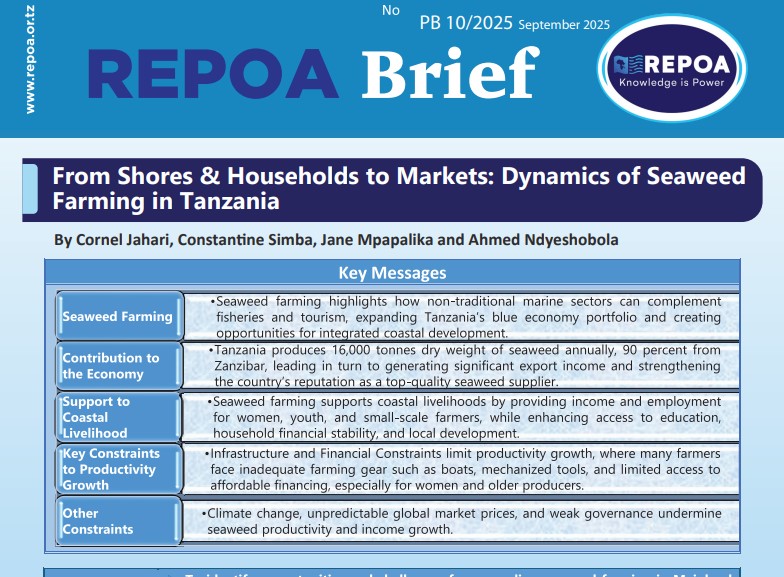
This Policy Brief identifies opportunities and challenges for expanding seaweed farming in Mainland Tanzania and Zanzibar, while strengthening sector resilience. READ ON…!
Learning from the Experience of the Namibian Blue Economy 2
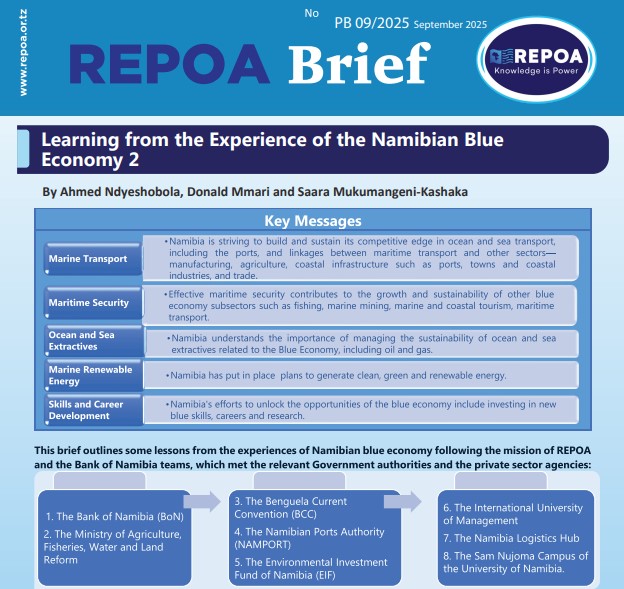
This Policy Brief outlines some lessons from the experiences of Namibian blue economy following the mission of REPOA and the Bank of Namibia teams, which met the relevant Government authorities and the private sector agencies there. READ ON…!
Gender equality and women’s empowerment: The unintended consequence of women’s access to the labour market
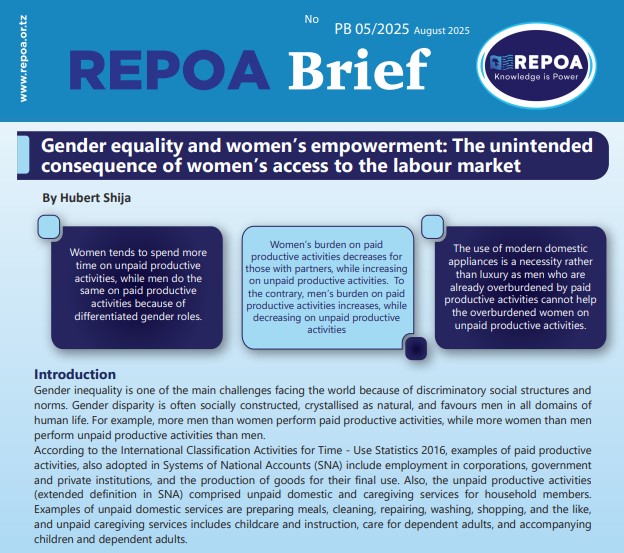
This Policy Brief compares the relative workloads of women and men based on a workload limit of 10:30 hours a day according to the Women’s Empowerment in Agriculture Index (WEAI) to inform the gender related policies. Read ON…!
The role of the services economy and trade in economic structural transformation and development trajectory in Tanzania
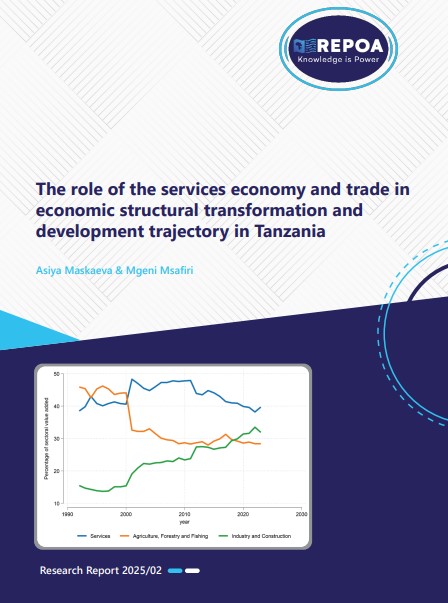
This Research Report provides a comprehensive overview of Tanzania’s position in the global economy, including its level and changes, through the lens of Gross Value Chains (GVCs), with a focus on the service sector. Studying the Tanzanian experience is not only interesting for its policy implications, but also because Tanzania is representative of small, open […]
Intrahousehold bargaining and Climate-Smart Agriculture: Productivity outcomes among female paddy farmers in Morogoro, Tanzania
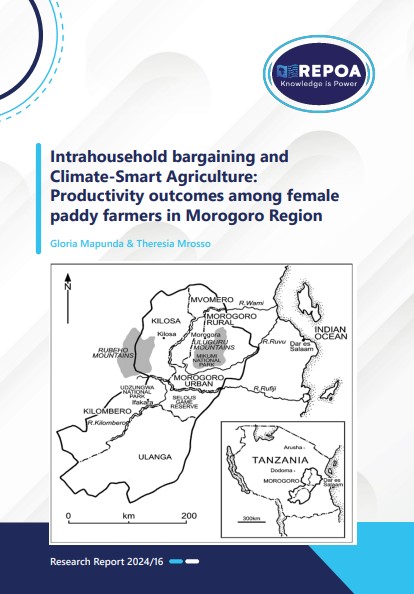
This study explores the drivers of women’s bargaining power in households, and their impact on Climate-Smart Agriculture (CSA) practices adoption in Tanzania, focusing on paddy production. The study uses data from 317 women farmers. Results reveal that, the adoption of CSA practices is influenced by factors such as women’s bargaining power, age, non-farm income, area […]
Unlocking the Blue Economy: Insights from the Fisheries Sector in Coastal Mainland Tanzania and Zanzibar
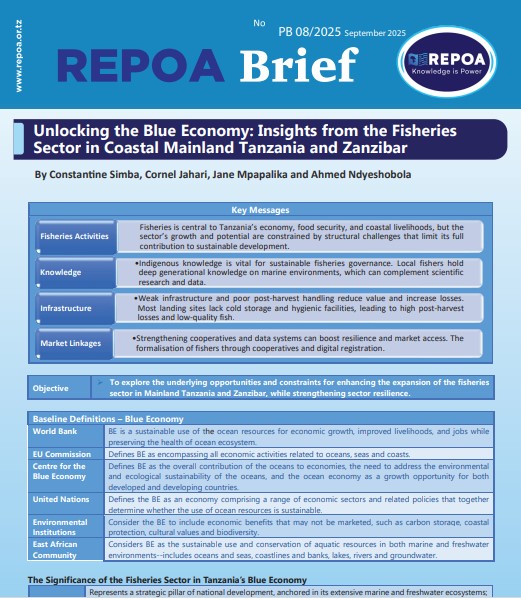
This Policy Brief explores the underlying opportunities and constraints for enhancing the expansion of the fisheries sector in Mainland Tanzania and Zanzibar, while strengthening sector resilience. READ ON…!
Learning from the Experience of the Namibian Blue Economy 1
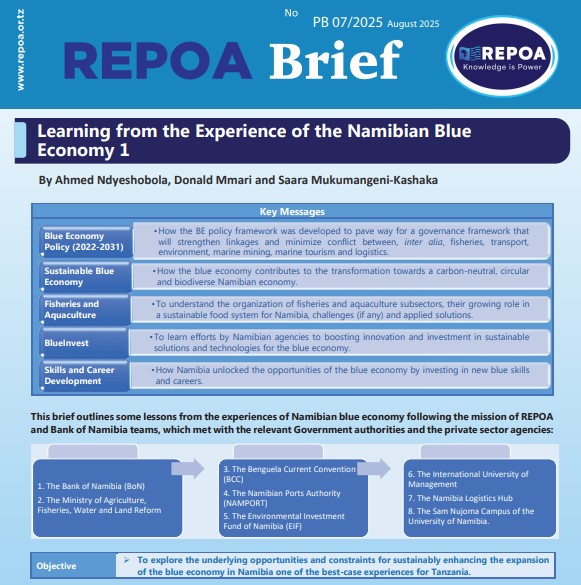
This Policy Brief outlines some lessons from the experiences of Namibian blue economy following the mission of REPOA and Bank of Namibia teams, which met with the relevant Government authorities and the private sector agencies there. READ ON…!