Publications

Our publications provide evidence-based research, policy briefs, and analytical papers that inform decision-making and contribute to national and regional development. They serve as a reliable source of knowledge for policymakers, researchers, development partners, and the general public seeking insights on key economic and social issues.

Policy Briefs

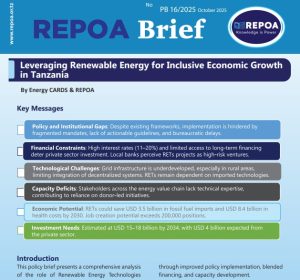
Leveraging Renewable Energy for Inclusive Economic Growth in Tanzania

This policy brief presents a comprehensive analysis of the role of Renewable Energy Technologies (RETs) in advancing inclusive economic growth in Tanzania. Despite the country’s vast renewable energy potential, the sector’s contribution to GDP remains below 2%, constrained by financial, institutional, and infrastructural barriers. READ ON…!

Read More »
Policy Briefs

Harnessing Tanzania’s Services Trade for Structural Transformation

This Policy Brief presents key findings from a study that investigated the impact of changes in the composition of services and trade sub-sectors on economic growth and transformation in Tanzania. Specifically, it offers a picture of Tanzania’s services trade profile and analyse the contribution of services trade to GVCs through

Read More »
Policy Briefs

Building productive capacities in Tanzania—opportunities and constraints in the coffee sub-sector

It is recommended that this framework of analysis is adapted to inform policy analysts, private sector practitioners, and decision makers in public institutions responsible for promoting economic growth; agriculture and cooperative development; investments, trade, and industrial development; private sector development, and providing the requisite political champion for the coffee sub-sector.

Read More »
Policy Briefs

Trust in tax administration: Why it matters for tax compliance

Trust is a foundational component of any tax system, particularly in environments where enforcement capacity is weak. In Tanzania, businesspeople exhibit low levels of trust in tax authorities, undermining voluntary compliance and weakening the legitimacy of the tax system. However, trust is not static; it can be built – and

Read More »